About us
Why BWB?
Bustards are the most imperiled family of terrestrial birds, with 60% of species listed as threatened or near threatened with extinction. Bustard populations are declining worldwide due to habitat loss from agricultural expansion and intensification, urbanization, and infrastructure development, compounded by hunting, power line collisions, and pesticide use.
Due to these sensitivities, bustards serve as indicators of healthy rangelands and sustainable agrarian landscapes: their conservation encompasses the protection of other declining grass- and shrubland species and ensures the productivity of the landscape for healthy human food supply.
Conservation strategies which focus on habitat protection, reducing illegal killing and unsustainable taking, and promoting sustainable land management are needed to reverse bustard population declines and ensure the preservation of these iconic species and their roles in our ecosystems.
Effectively addressing these issues requires a united and urgent effort involving diverse organizations and stakeholders from all areas with bustard populations working together under a common umbrella.
Who is BWB?
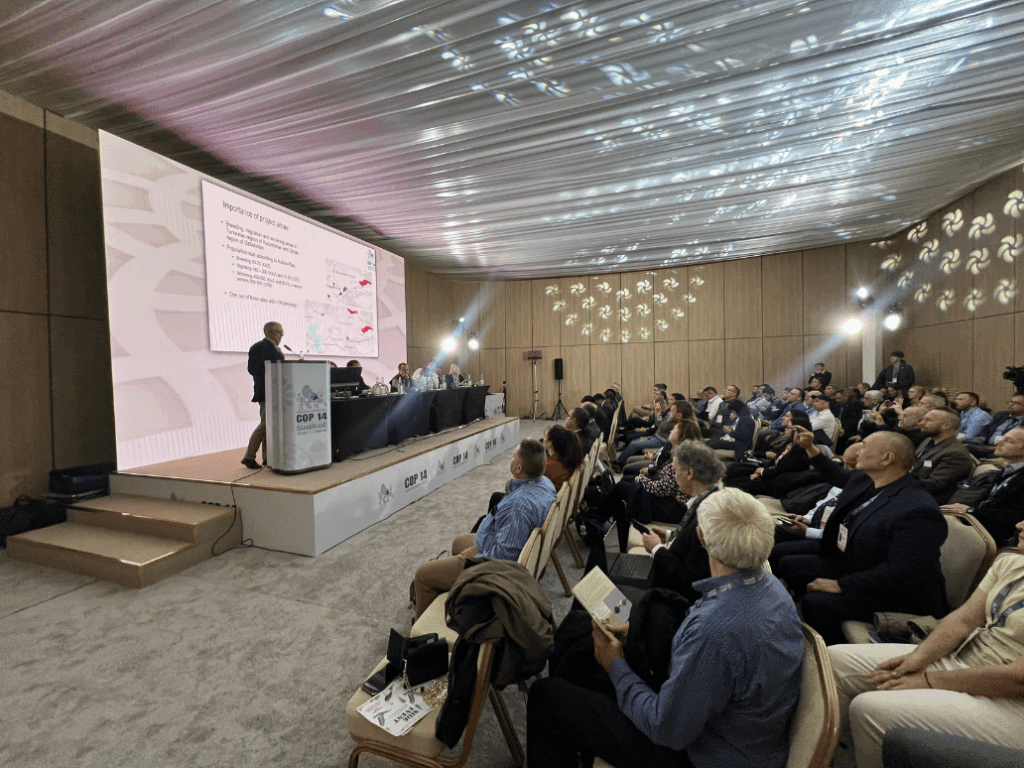
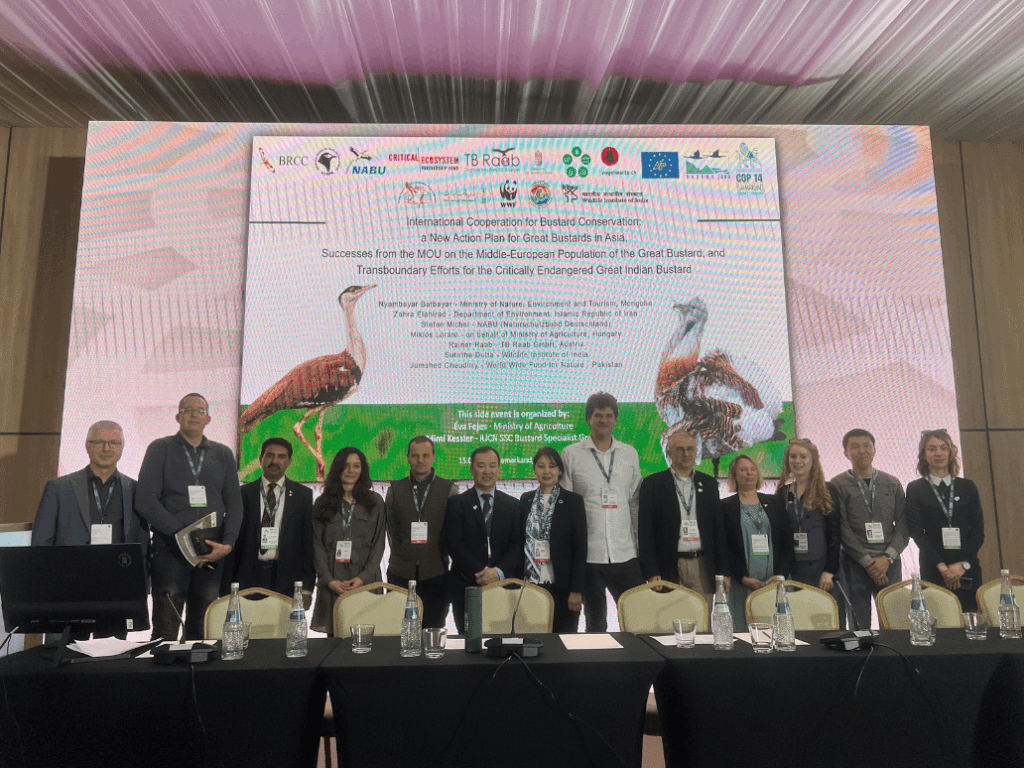
First idea to create BWB was at the COP14 in Uzbekistan after the side event.
Bustards Without Borders is a consortium of individuals, organizations, government institutions and other stakeholders with established expertise and commitment to sustainable bustard conservation. Members work together to share best practices, coordinate and advance the conservation of all bustard species across their ranges on four continents.
Our mission
BWB is dedicated to catalyzing actions for the sustainable conservation of bustards and their habitats, to include on-the-ground conservation activities, training, awareness, population monitoring and research as outlined in the Multi-species Action Plan (MsAP) to conserve African, Eurasian and Australian Bustards adopted in March 2026, at COP15 of the Convention on Migratory Species. We now turn our attention to implementation of the first Program of Work for the Action Plan. We take a collaborative approach to engage relevant and committed individuals from diverse geographic, institutional and professional backgrounds. The Bustard MsAP is a tool to mobilize governments and stakeholders worldwide, foster synergies, and promote coordinated efforts.
Scope: Species and geographic coverage
The Bustard MsAP covers all 26 species of bustards worldwide. The MsAP identifies 102 Range States hosting populations of one or more of these bustard species (Figure 1).
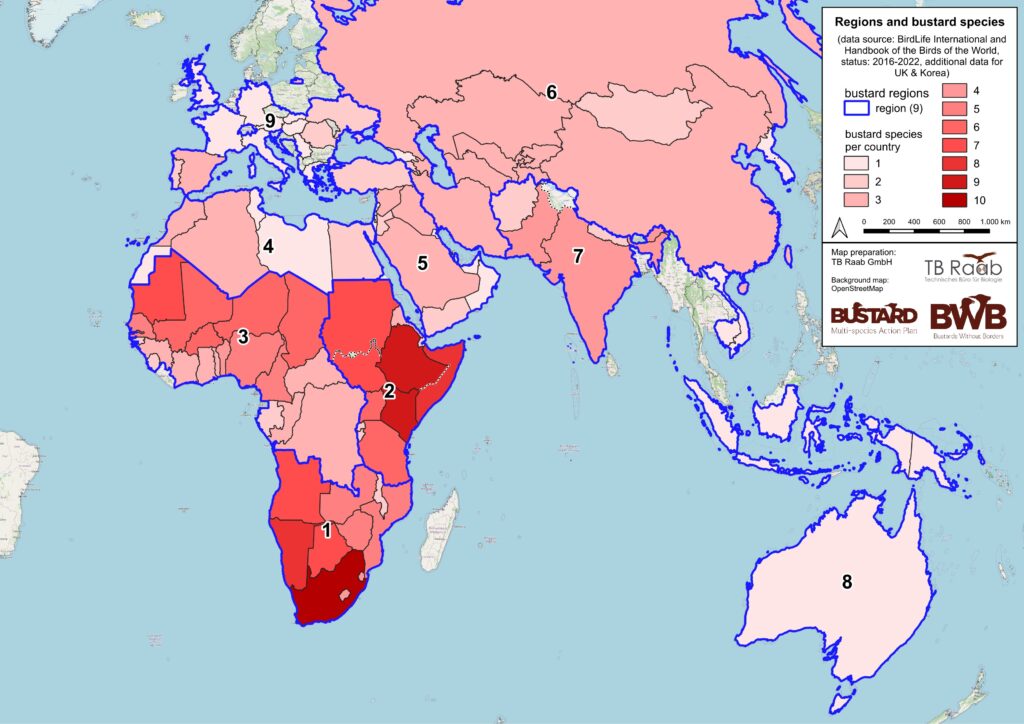
Figure 1. Overview of geographic scope of the Bustard MsAP and geographic units of BWB, encompassing 26 bustard species across 102 Range States. Number of species per country is indicated by the shade of red. Bustards Without Borders coordinates our work by dividing range states into nine regions, each with a Regional Coordinator.
BWB regions:
- 1 – Southern Africa
- 2 – Eastern Africa
- 3 – Western Africa
- 4 – Northern Africa
- 5 – Southwest Asia
- 6 - Central and East Asia
- 7 – South Asia
- 8 – Australia
- 9 – Europe
Our relationship to CMS
BWB harks to UNEP/CMS/Resolution 10.27 on Improving the Conservation Status of Migratory Landbirds in the African-Eurasian Region, adopted at CMS COP10, which calls upon Parties to undertake immediate and concerted international actions to conserve African-Eurasian migratory landbird species and their habitats throughout the flyway. BWB is positioned within the African-Eurasian Migratory Landbirds Action Plan (AEMLAP), which was initiated in response to Resolution 10.27. The most recently revised AEMLAP Resolution adopted at COP14 specifically addresses the necessity of mitigating threats to migratory bustards.*
*According to the Resolution on AEMLAP (UNEP/CMS/Resolution 11.17 (Rev.COP14)), the Conference of the Parties ‘Further calls on Parties to urgently take practical measures to address threats to migratory bustards, a highly threatened and declining group of migratory landbird species under particular pressure from illegal killing, unsustainable taking, collision with energy infrastructure and habitat loss and degradation including as outlines in relevant Species Action Plans.’